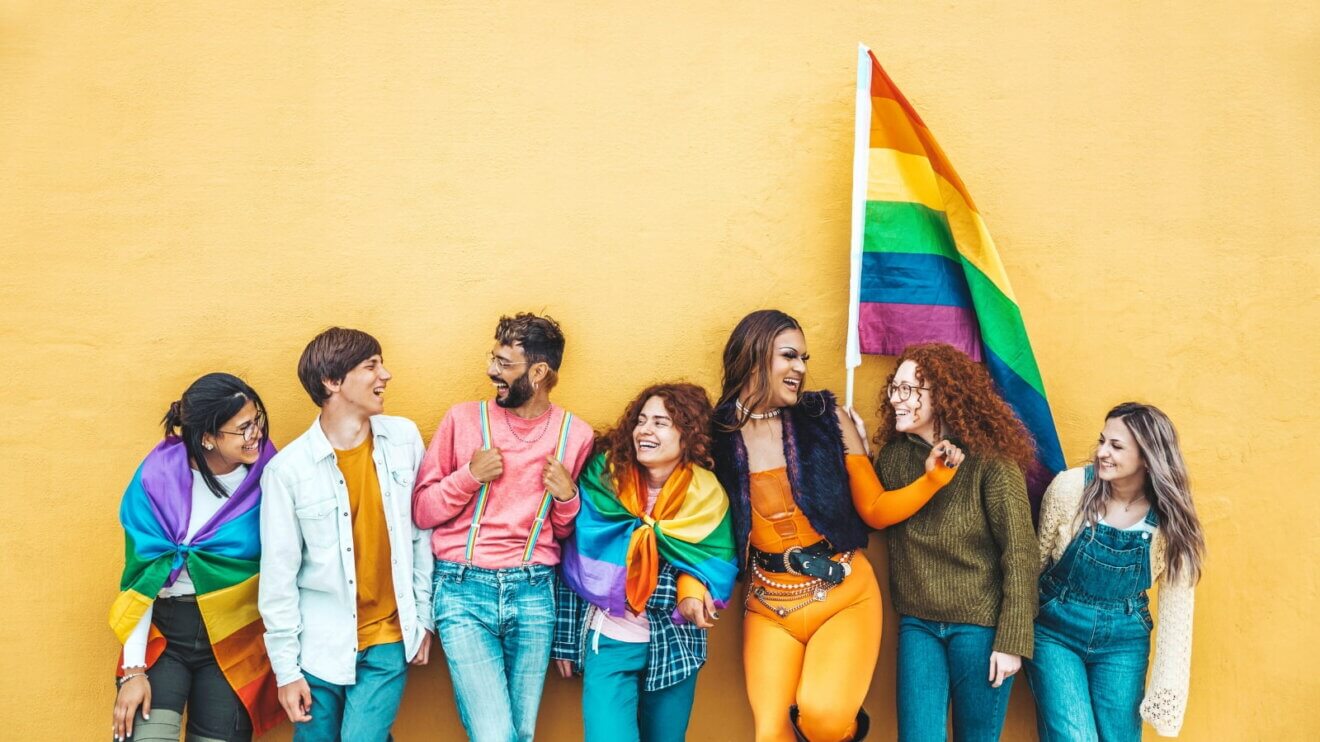

This year, plenty of companies that spent the last decade rolling out rainbow logos for Pride Month quietly sat it out instead, citing political backlash, fears of boycotts and pressure to walk back DEI commitments. It’s a reminder that corporate support for LGBTQ employees has always been conditional, dependent on whatever climate companies think they can survive. But long before anyone debated whether genuine allyship was worth the political risk, queer employees at one of America’s most iconic companies were already doing the hard work without any of the institutional backing we now take for granted. In the early 1980s, employees at Kodak organized first in secret, then in the open and changed their company’s culture from the inside out. Tamar Carroll, associate professor of history at the Rochester Institute of Technology, traces that history for The Conversation.
As corporations sponsor floats and employee marches during Pride Month parades, it’s important to remember just how recently the majority of American office workers felt they had to conceal their sexuality in the workplace.
In the 1970s, there were no legal protections for LGBTQ workers outside of a handful of cities. If a company found out you were gay, it could fire you on the spot.
It took a group of pioneering LGBTQ workers in the 1980s and ’90s who challenged widespread homophobia in corporate America to make workplaces safer and more inclusive, not only for LGBTQ workers but for everyone.
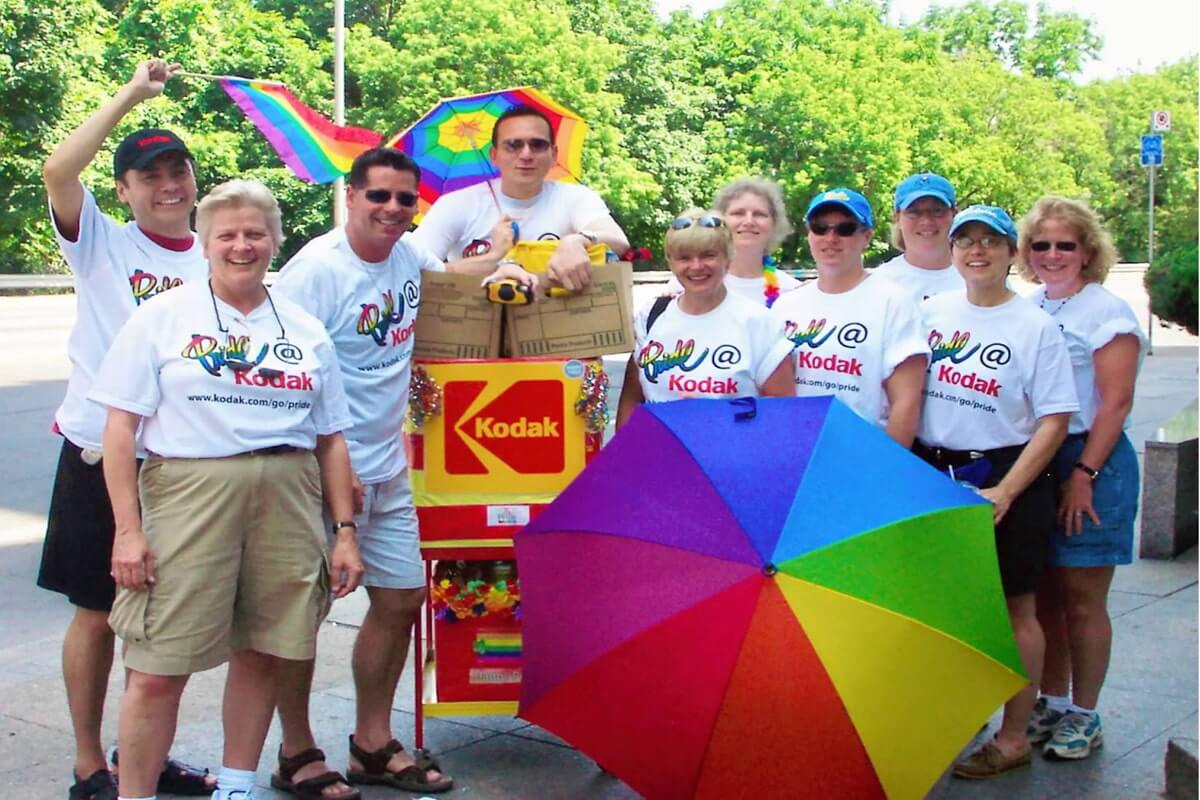
Since 2021, I’ve been studying LGBTQ workplace rights activists at one of those corporations: Kodak.
The iconic camera and film manufacturer has been headquartered in Rochester, New York, since 1881. At a time when most employees were closeted, a group of the company’s gay, lesbian, bisexual and trans employees came together to form the Lambda Network to reshape Kodak’s corporate culture and company policies. The company officially recognized the group in 1993.
Alongside my undergraduate research assistants at the Rochester Institute of Technology, I’ve been documenting and preserving the history of the Lambda Network.
We’ve interviewed more than 30 Lambda members and their allies. Even as Kodak filed for bankruptcy in 2012 and emerged as a significantly smaller company, many Lambda members kept their records, giving us access to a unique archive that includes corporate policies, correspondence, photographs and video footage.
‘The early years were scary’
Many Lambda members shared their stories with us and explained how difficult it was to remain closeted at work in the 1970s and ’80s.
It could mean silently tolerating homophobic jokes, having to conceal one’s private life from co-workers, and living in fear of the consequences of being outed, which could include being socially ostracized and even losing your job.
As Kodak executive Cynthia Martin, who later came out as a lesbian and became a corporate champion for Lambda, recalled, “Rochester was a Kodak town, so you’d always run into people (from work). … If it was Valentine’s Day and you were out at a restaurant (with your partner) or, you know, even just grocery shopping, it was awkward. And that was just an everyday occurrence, so it was hard. It was stressful.”
At a time when there were few workplace protections for LGBTQ workers, coming out was even more terrifying. The U.S. Supreme Court would not rule until 2020 that workers cannot be terminated based on their sexual orientation, and few states had LGBTQ labor protections in place. The AIDS crisis of the 1980s amplified homophobia; some companies, like Cracker Barrel, were firing employees for being gay as recently as 1991.
Analytical chemist Emily Jones, who started working at Kodak in 1975, was one of Lambda’s founding members. She began coming out in her private life in the 1980s but remained closeted at work.
“The early years were scary,” Jones said. “I remember coming out to my boss, who told me he sent his son to Utah to be saved for being gay. You worried about it, you got stomachaches, you threw up, you thought about leaving your job. I was a single mom then.”
Part of what gave Jones the courage to come out and to become a leader at Lambda was the broader LGBTQ workplace equality movement taking place in companies across the U.S.
LGBTQ employees at Xerox, AT&T, Apple, Bausch and Lomb, IBM and Corning were also forming employee resource groups to provide support, build community for queer workers and encourage them to come out of the closet. They educated co-workers and managers about the challenges LGBTQ workers faced and advocated for equitable benefit policies, including health insurance for domestic partners, bereavement leave and adoption benefits.
Beginning in the mid-1990s, LGBTQ activists from leading Fortune 100 corporations would meet at yearly Out & Equal conferences to network and share strategies for creating LGBTQ-inclusive workplace cultures. They also shared data in order to overcome wrongful assumptions about how much implementing health insurance for domestic partners would actually cost corporations and to advocate for changes to the federal tax code, which imposed penalties on health insurance benefits for same-sex domestic partners but not for heterosexual married couples.
Photography as activism
At the 1990 Gay Games in Vancouver – the world’s largest LGBTQ sporting event – two Kodak employees met and discussed creating a monthly support group for their gay and lesbian colleagues.
Encouraged by Susan Connelly, the leader of Kodak’s Human Resources Diversity Initiative, they began meeting regularly. In 1993, the group hosted its first public event, which featured Deb Price, the first nationally syndicated columnist on gay life. In 1995, Lambda invited Elizabeth Birch, who had secured domestic partner benefits at Apple and would go on to lead the Human Rights Campaign, to headline their first educational event with Kodak’s executives. It was attended by Kodak CEO George Fisher and his wife, Anne, and their support for Lambda proved decisive in transforming the corporate culture.
While Kodak’s LGBTQ workers soon found they had much in common with their queer colleagues at other corporations, their activism also built upon Kodak’s distinctive identity as a photography company.
At Lambda events, the group often included a popular photo booth equipped with Kodak technology to provide free, professional-grade portraits to attendees. Queer people were encouraged to get their portraits taken with their partners and to display them in their workplaces as a way of coming out.

The group also brought important early LGBTQ family photography projects, such as Love Makes a Family and FAMILY: A Portrait of Gay and Lesbian America, to Rochester, staging exhibitions of the works in several locations across Kodak’s campuses.
Both initiatives helped convey the same messages: It was important to be visible. LGBTQ couples might be unique in some ways, but they were also similar to heterosexual couples in many other ways. And behind all the heated political rhetoric were real people with real families.
By incorporating queer family photography into their activities, Lambda members smartly tied their own organization’s goals and identity to that of Kodak. For decades, the company had encouraged Americans to take and display family photographs via its iconic advertisement campaigns.

Simply the right thing to do
Lambda’s educational efforts at Kodak didn’t just compel the corporation to change its own policies, which included implementing domestic partner and adoption benefits, as well an early policy on gender transitioning in the workplace. They also led to Kodak becoming a national leader in LGBTQ rights, with executives testifying before Congress in favor of nondiscrimination in employment bills.
Because of Lambda, Kodak’s marketing team implemented gay and lesbian themes into the corporation’s advertisements. This helped normalize depictions of same-sex couples and contributed to Americans’ broader acceptance of LGBTQ rights and people in the 1990s and 2000s.
Perhaps most importantly, workplace activists in Lambda and beyond transformed American corporate culture from one in which sexist, racist and homophobic jokes and remarks were commonplace and tolerated into one that generally aspires to value diversity and celebrate differences.
Lambda’s straight allies at Kodak, like those at many other companies, learned that an inclusive environment allowed everyone to be more authentic at work.
To me, Lambda’s history reveals the power that workers have when they come together as a group and share their stories. It also reveals how much is at stake in current efforts to roll back protections for LGBTQ people – particularly trans rights – and to dismantle diversity, equity and inclusion programs.
In 2002, Kodak’s vice president of human resources, Robert Berman, told Congress that embracing diversity wasn’t just a business imperative. It was simply the right thing to do.
I know that’s still true today.






Add Comment